
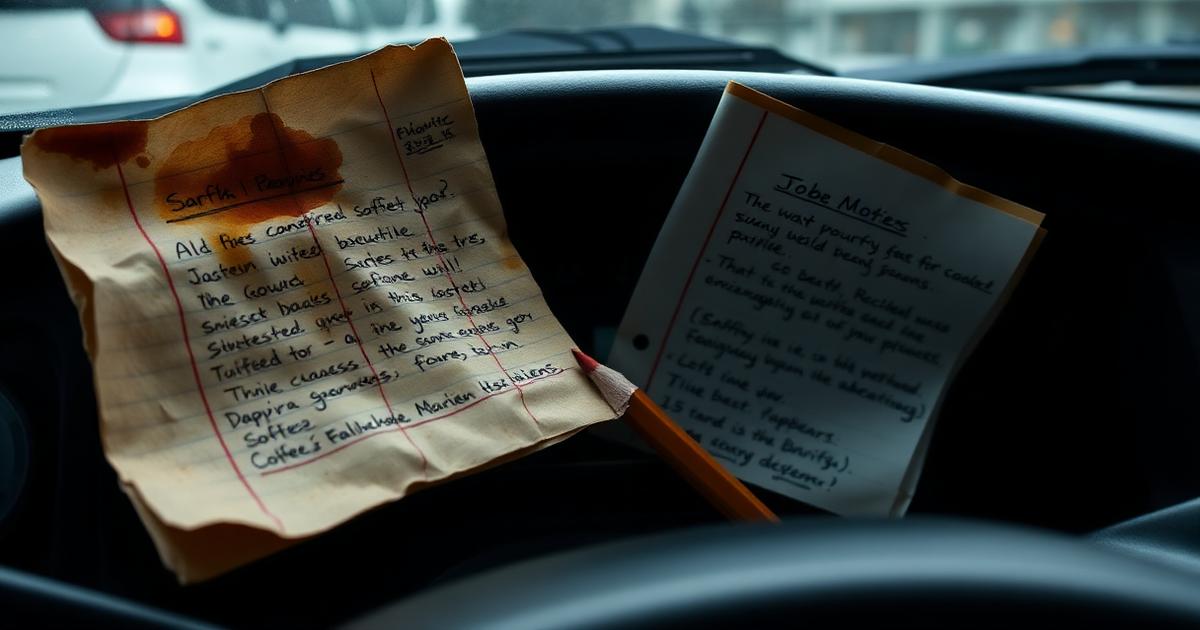
Every home service business has a shoebox somewhere. In the shoebox — or the glovebox, or the back-office drawer — is a pile of notebooks with job notes in them. Measurements, sketches, part numbers, prices agreed at the door, verbal variations, "she said not to bother with the second radiator". This pile of paper is treated as harmless nostalgia. It is, in fact, one of the largest sources of financial and legal risk in the business.
Paper doesn't survive real work
The obvious problem with paper is that it doesn't survive the environment. Notebooks get wet, get lost, get left on top of the water heater, get thrown out when the van is cleaned. Studies of construction and trades documentation consistently find that 20–40% of handwritten job notes are illegible or missing within six months.
This wouldn't matter if the notes weren't important. They are. They're the only record you have of scope agreed on site, verbal variations, materials used, and problems flagged. When any of those become disputed — and eventually one will — losing the record loses the argument.
The three scenarios that will happen to you
Every home service pro will eventually face at least one of the following.
The variation dispute. Six weeks after a bathroom refit, the customer refuses to pay the final third because "you never told me the mixer was extra". You know you told them at the door on day four. You wrote it in your notebook. Your notebook is gone. Without the record, you either eat the loss or spend three months in small claims court.
The warranty callback. A boiler you installed 18 months ago fails. The customer says you fitted the wrong flow rate for their system. You know you didn't — you spec'd it correctly and noted it. Your notes for that job are in a notebook you can't find, from an employee who's since left. You can't prove your case. You replace the boiler at cost.
The insurance claim. A leak damages a kitchen ceiling. The homeowner claims you did the pipework six months ago and it failed. You did work in that property, but not on that pipe. Without dated photos and notes, you can't disprove it. Your insurance premium goes up, and you carry the excess.
Each of these scenarios is between £2k and £20k of exposure per event. They happen more often than pros want to admit.
What paper can't do
Beyond the risk, paper is genuinely bad at the job. Paper notes can't be searched. Can't be shared with the office. Can't be linked to photos. Can't be dated with certainty. Can't be exported to your accountant. Can't be produced in court in a form that's obviously untampered.
None of these are minor. Every one of them costs time, money or credibility.
What good digital records actually contain
A proper digital job record isn't just "a PDF of the invoice". It's a chronological log of everything that happened on that job, with automatic timestamps and photos, that can't be edited retrospectively without a trail.
At minimum it should include: the original request, the site visit notes, the initial quote, any accepted variations with proof of approval, arrival and completion timestamps, photos before / during / after, materials used, warranty terms, invoice and payment record.
If any of that is disputed later, you produce the record. Disputes evaporate. Insurance claims are easier to defend. Warranty callbacks are settled in minutes, not weeks.
The compliance angle
Depending on jurisdiction and trade, home service pros face growing documentation requirements. Gas engineers need Gas Safe records. Electricians need EICR certificates. Roofers may need to prove RAMS. Cleaners in commercial or short-term rental contexts increasingly need proof-of-service records.
These aren't optional. Regulators and insurance providers are steadily raising the documentation bar. Businesses still running on paper will find themselves out of compliance without noticing, until an inspection or a claim exposes it.
Photos are the killer feature
The single most powerful upgrade from paper to digital isn't the text — it's the photos. Home service pros already take photos on their phones. What paper doesn't do is link those photos to the job record. They sit in the camera roll and disappear.
A proper job management system captures photos into the job, timestamped and geotagged. That single change turns your photo history into legal evidence, warranty proof and marketing material simultaneously.
The transition isn't as hard as it looks
Most pros resist the switch from paper because it feels like a big change. In practice, the transition is a week. You keep the notebook in the van for the first two weeks as a safety blanket, then discover you're not opening it, then it disappears.
The pros who make the switch almost always say the same thing: "I can't believe how much I was carrying in my head."
What to do this week
Pick your next job. Log every note in a digital system instead of paper. Photograph everything. Time-stamp the variations. Message any approvals through the system so there's a written trail.
Do the same for the next job. And the next. Within a month the paper habit will be broken.
Absolutely turns every job into a structured, timestamped record with photos, variations, approvals and completion sign-off — the evidence trail you didn't know you were missing. Free for a limited time.