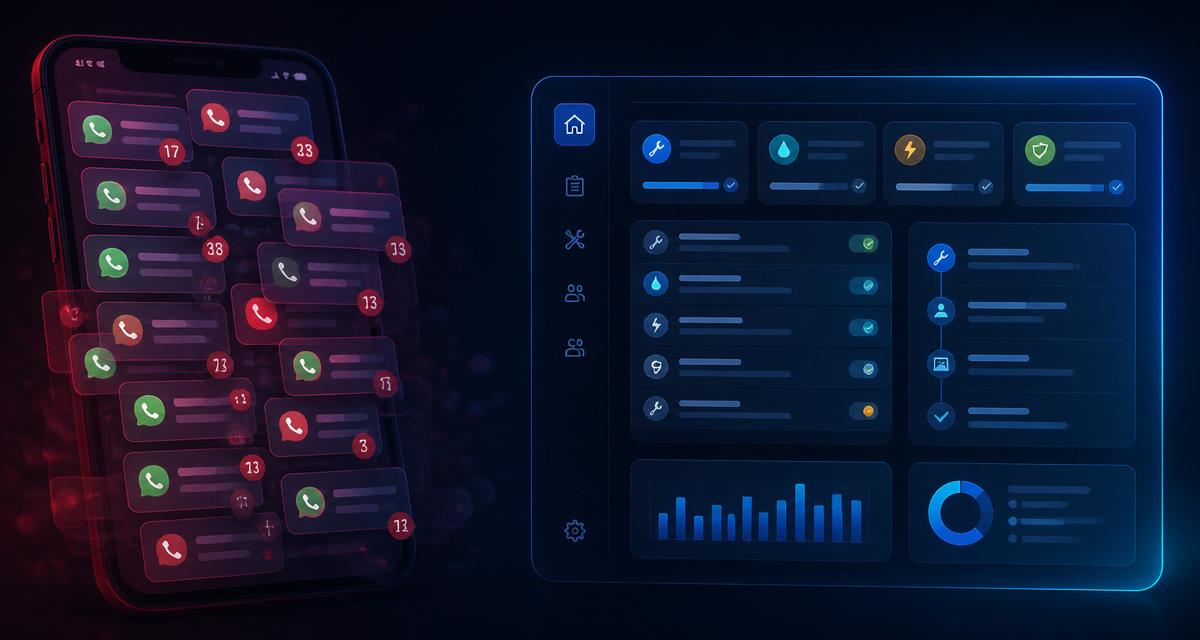
WhatsApp is how most home service businesses get off the ground. It's free, everyone has it, and when there are two of you in a van you can literally shout at each other over the noise of the compressor and follow up with a photo. The problem is that WhatsApp was designed for family chat groups and holiday snaps, not for running a company that turns over six or seven figures a year.
If you're a plumber, sparky, roofer, HVAC tech, cleaner or handyman doing more than a handful of jobs a week, the app is almost certainly the ceiling on your growth right now — and you probably can't see it because you're still busy answering it.
The three signals your WhatsApp workflow has broken
There are three moments almost every home service pro hits before they admit WhatsApp isn't cutting it any more.
The first is the missing photo. A property manager sends "before" photos of a leak on Tuesday. On Friday, when you finally get to quote, you have to scroll through 400 unread messages and 12 group chats to find them. Half the time the images have expired from your phone's cache and you have to ask the PM to resend, which makes you look disorganised on the very first touch.
The second is the double-booked job. A homeowner asks in DM if you can come Thursday morning. You say yes. Your apprentice, in a separate chat, has already agreed to a boiler service at the same slot. Nobody wrote it down anywhere shared. Somebody gets stood up, and you lose either a customer or a Google review — sometimes both.
The third is the quote that never went out. You mentally quoted a job at the door, promised to "send it over tonight", got called out to an emergency, and forgot. Two weeks later the customer books someone else. You never even knew you lost it. Multiply that by three or four jobs a month, and you're leaking £30k a year in silent revenue.
Why the tool matters more than the discipline
The instinct at this point is to blame yourself. "I just need to be more organised." "I'll get a better notebook." "I'll pin the important chats." None of that works, because the medium is the problem, not the operator. WhatsApp doesn't have a concept of a job. It has a concept of a conversation. Everything you do — quoting, scheduling, dispatch, invoicing, proof of work — has to be reverse-engineered out of a flat stream of messages that belongs to a phone, not a business.
That means when your apprentice leaves, the history of every job they ever touched leaves with them. That means when a customer disputes a variation six months later, you can't reliably prove what was agreed. That means when you try to hand dispatch to your office manager, they can't see the pipeline because the pipeline lives in your phone.
What a real task management system does differently
A proper system built for home service work turns each customer request into a persistent record — a problem — that lives independently of any single person's phone. The photos, the quote, the accepted price, the assigned tech, the on-site variation, the completion photos and the invoice all sit under one link that everyone on the team can see.
Instead of a chat log, you have a workflow. Instead of "who's got the number for that landlord?", you have a searchable database of every property you've ever worked on. Instead of "did we quote that or not?", you have a status column that tells you at a glance.
The good news is you don't have to build it yourself. Platforms like Absolutely exist to replicate the speed and simplicity of WhatsApp but with the structure of a real operations tool. You still get instant photo capture. You still get direct messaging with the customer. You just also get a system that doesn't lose things when your phone dies at 5 p.m. on a Friday.
The migration is easier than you think
The single biggest blocker to leaving WhatsApp isn't functionality — it's the fear that customers won't follow you. In practice, they don't need to. When a job is logged in a proper system, the customer gets a link. They can send photos, approve quotes and message you through that link without downloading anything. They still think they're texting you. You're the only one who knows there's structure behind the scenes.
Start with your next new job, not your entire back catalogue. Log it in the platform, quote it from the platform, dispatch from the platform, complete it in the platform. Do the same with the job after that. Within a fortnight, you'll notice you're checking WhatsApp less and finishing days earlier.
The upside nobody talks about
The real prize isn't the time saved on admin, though that's usually five to eight hours a week per person. The real prize is what a proper record unlocks. Once your jobs are structured, you can quote from templates instead of from scratch. You can see which trades are most profitable. You can hand your books to an accountant without three days of reconciliation. You can bring on a second technician without doubling your headaches. You can sell the business one day and have something to actually sell.
WhatsApp is a fine place to start a home service business. It is a terrible place to grow one. If any of the three signals above rang a bell, treat this as the nudge — the ceiling isn't your work ethic, it's the tool.
Absolutely is free for a limited time for home service pros making the switch. Sign up, log your next job through it, and see what a week without WhatsApp chaos feels like.