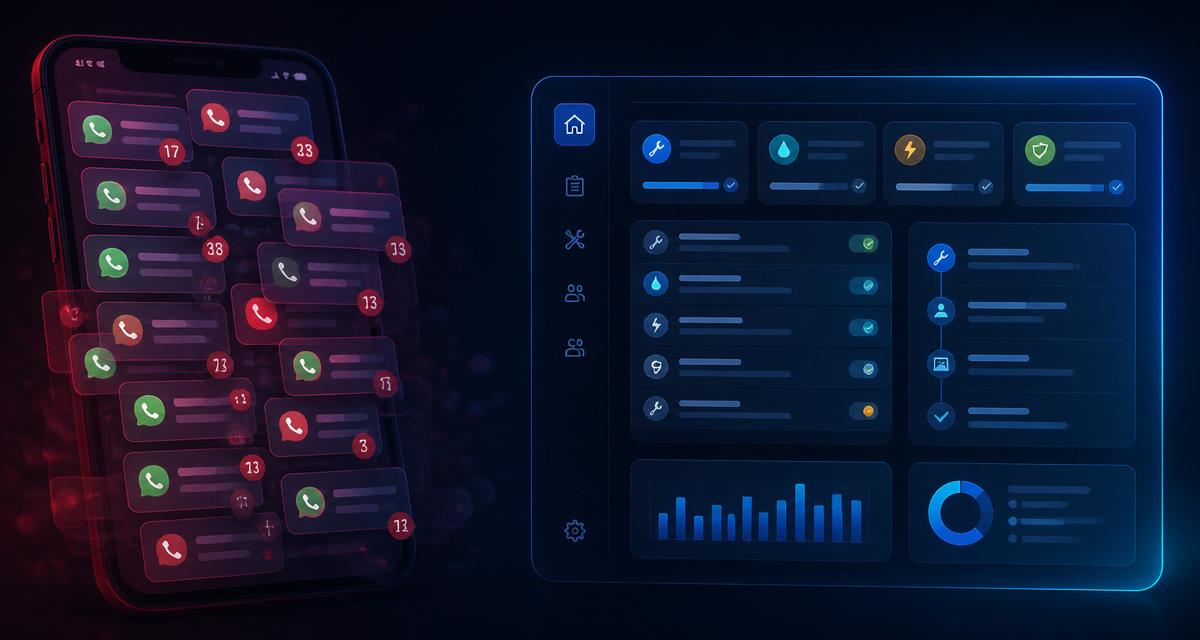

For many home service pros and maintenance teams, the biggest operational problem is not lack of skill. It is message chaos.
A job comes in by phone. A photo arrives by WhatsApp. The access code is sent by text. The invoice goes by email. A follow-up question sits in voicemail. By the end of the day, nobody has one complete view of the job.
This is how good contractors accidentally miss work, delay updates, or look disorganised even when they are working hard.
Message chaos creates real business risk
When maintenance jobs are scattered across channels, several things happen:
- Important details get missed.
- Clients chase for updates you already gave somewhere else.
- Photos and notes are hard to find later.
- Team members cannot easily pick up where someone else left off.
- Jobs are completed but not closed properly.
- Follow-up work is forgotten.
For property managers, hosts, landlords, and facilities teams, this creates stress. For contractors, it creates avoidable admin and lost revenue.
A job is not a message. It is a workflow.
A maintenance issue usually has several stages: reported, reviewed, assigned, accepted, scheduled, attended, updated, completed, invoiced, and closed. If those stages are managed only through messages, the process depends on memory.
Memory is not a system.
A clearer approach is to treat every maintenance problem as a tracked workflow. That means each job has a place where the key details live:
- What is the issue?
- Who reported it?
- Which property is affected?
- Who is assigned?
- What is the current status?
- What photos, notes, and approvals are attached?
- What happens next?
Once that information is centralised, communication becomes much easier.
Contractors benefit from cleaner job intake
When clients send better job information, contractors can work faster. A clear job brief reduces back-and-forth, failed visits, and wasted travel time.
Good job intake should capture:
- The property address.
- The affected area or room.
- Photos or video.
- Access instructions.
- Occupancy status.
- Urgency level.
- Contact person on site.
- Permission limits for small repairs.
If that information arrives in one place, the job starts properly.
Updates should be attached to the job, not lost in a thread
One of the biggest advantages of a central maintenance workflow is that updates stay connected to the issue. The client should not need to search through email, WhatsApp, and text messages to understand what happened.
For contractors, this also reduces disputes. If the job record shows when you attended, what you found, what photos were taken, what was approved, and what was completed, everyone has a clearer picture.
Use communication channels, but do not let them run the job
Phone calls, texts, WhatsApp, and email are still useful. The problem starts when they become the only system. A better model is to use those channels for quick communication while keeping the job record centralised.
That way, if someone asks "what is happening with the boiler at Flat 4?" there is one place to look.
Final thought
Contractors do not lose jobs because they cannot do the work. They lose jobs because the work is hard to track, hard to update, or hard to prove later.
Absolutely is designed to reduce inbox chaos by centralising maintenance issues, updates, contractor communication, and workflow tracking. For service professionals, that means fewer missing details, fewer chasers, and a better experience for property clients.
Still managing maintenance from scattered messages? Absolutely helps turn reports, updates, assignments, and completions into one clearer workflow. Free for a limited time.