
Home service pros usually get their start with homeowners. It's the natural first market — a neighbour needs a tap fixed, they tell a friend, referrals happen. Eventually most pros pick up their first property manager, discover it's the fastest path to consistent volume, and start chasing more. Then they discover PMs and homeowners are, in almost every meaningful way, opposite kinds of customer.
Understanding the difference is the difference between a stressful business and a scalable one.
The homeowner customer
Homeowners are buying two things when they hire you: fixing the problem, and being reassured that the problem is fixable. They usually haven't hired your trade before, they don't know what fair pricing looks like, and their default emotional state is anxious. They want you to make eye contact, explain what you're doing, take your shoes off, and leave the place clean.
Because they only need you once every few years, they're not repeat customers in a systematic way. What they are is a review machine. A well-served homeowner leaves you a 5-star Google review, tells three neighbours, and posts in the local Facebook group. A badly-served one warns 15 people. Homeowner economics live and die by reputation.
Practical implications: over-communicate. Send an "on my way" message. Send an end-of-job photo report. Follow up 48 hours later. Ask for the review by name. Don't rush the goodbye conversation.
The property manager customer
Property managers are the opposite. They've worked with dozens of contractors. They know what pipes cost. They aren't emotional about the boiler — it's a line item in a portfolio. What they want is: speed of response, predictable pricing, clean paperwork, and no drama.
They don't care if you take your shoes off, because they're not there. They care if you invoiced the right entity, in the right format, within their reporting cycle. They care if the tenant complained, because they had to field the call.
PM economics live and die by operational consistency. A well-served PM books you three times a month for the next five years. A badly-served one drops you after one bad invoice.
Practical implications: nail the paperwork, hit the SLA, communicate proactively when things slip, and never surprise them on price.
What each one hates
Homeowners hate: feeling ignored, being talked down to, mess, and unexpected bills.
Property managers hate: chasing you for updates, invoices that don't match the PO, tenants complaining, and pros who can't scale with them.
If you serve both, you have to actively context-switch. What delights a homeowner (a friendly 15-minute chat about their extension) irritates a PM (why is this taking so long?). What satisfies a PM (a terse, itemised invoice with a job number) confuses a homeowner (what's a job number?).
The pricing conversation is different
Homeowners want to feel like they're getting a fair deal. They compare quotes. They ask friends. They'll pay a premium if you explain why. They don't want to negotiate — they want to feel confident.
Property managers want the lowest defensible price with the highest reliability. They will negotiate. They'll want a schedule of rates for common jobs. They'll want you to hold prices for the year.
Different pricing strategies. Same business. If you use one pricing playbook for both, you'll either underprice the homeowners (leaving money on the table) or overprice the PMs (losing volume).
The communication cadence is different
For homeowners, communication is a feature. Send updates. Explain what you're doing. Photograph the problem before you fix it.
For property managers, communication is overhead. Send only the updates that require action — arrival, completion, any variation, invoice. Batch everything else into a weekly summary. Every unnecessary message costs them time.
If you send the same volume of updates to both, you'll annoy one or under-serve the other.
Splitting the operation
Once you're serving both segments seriously, most successful HSPs split their operation. Homeowner work goes through one intake queue with a "concierge" tone. PM work goes through a separate queue with an "operations" tone. Pricing sheets, quote templates and invoice formats differ between the two.
You don't need two businesses. You need two workflows inside one business.
The volume trap
Property managers can offer volume that looks irresistible. It's tempting to drop homeowner work and go all-in on PMs. Two problems.
First, PMs concentrate risk. Losing one PM can be 30% of your revenue overnight. Homeowners are diversified.
Second, PM work is lower margin. It has to be, because they're comparing you to other pros. Homeowner work often carries 15–20 points more margin because you're the trusted expert, not a tendered supplier.
The best mix for most home service businesses is usually 60–70% PM work for the volume, 30–40% homeowner work for the margin. Adjust based on the local market.
The system that serves both
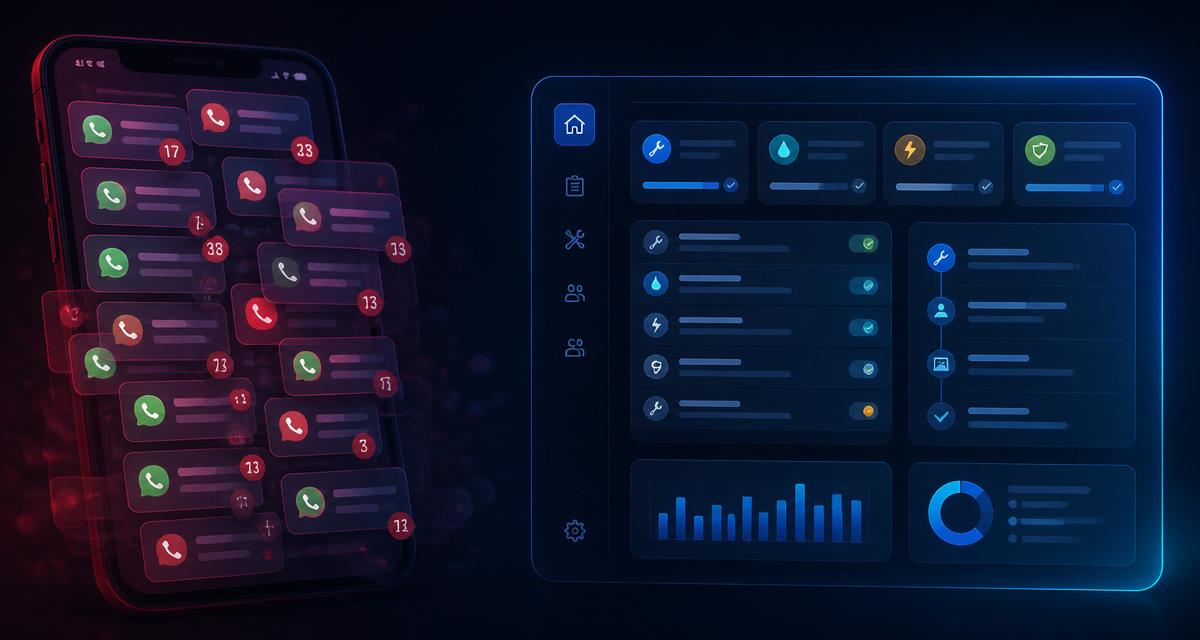
Serving two different customer types with different needs is exactly the kind of thing that overwhelms a phone-and-notebook operation. It's also exactly the kind of thing a proper task management platform is designed for — different intake queues, different quote templates, different invoice formats, different communication cadences, all under one roof.
Absolutely handles PM and homeowner workflows side by side, with the paperwork PMs need and the reassurance homeowners want. Free for a limited time.