
Every home service pro has a complicated relationship with emergency callouts. On paper they're the best-paid work available — customers in crisis don't negotiate, and the rates are typically 2–3x standard. In practice, most pros do them badly, either burning out from constant night calls or scaring off regular work because they can't quote emergencies properly.
There is a specific way to structure emergency work so it becomes the highest-margin, lowest-hassle part of your business. Most pros never learn it.
Why emergency work is uniquely valuable
Three properties of emergency work make it structurally more profitable than standard work.
Urgency removes price sensitivity. A homeowner with a burst pipe at 11pm is not shopping around. They want it fixed. They will pay whatever the going rate is. The margin per hour on emergency work is usually 2–4x standard hourly work.
The competitive set is thin. Most pros don't answer their phones after 6pm. Being one of the few who does gives you a monopoly-like position in your area for a specific customer segment.
Emergency customers become loyal customers. A pro who saves someone from a flooded kitchen at midnight becomes their pro for life. Emergency work is one of the highest-converting acquisition channels for future standard work.
Why most pros do it badly
Despite the upside, most pros lose money on emergency work. Three reasons.
They underprice. They charge their standard rate plus a small out-of-hours premium, when they should be charging 2–3x. They feel guilty. They lose money.
They don't have a structure. Every emergency is a fresh scramble. Which tech is on call? What are the on-site materials? What's the minimum charge? Without a system, every callout is a stressful negotiation.
They don't ring-fence the time. They accept emergencies alongside a full day of standard work, meaning both suffer. Emergency work needs its own protected capacity.
The three-tier emergency structure
Well-run home service businesses split emergency work into three tiers.
Tier 1: True emergency (life/property risk). Burst pipes, gas leaks, electrical fires, no heat in winter, no hot water for vulnerable households. Committed 2-hour response. Priced at 2.5–3x standard hourly rate, with a minimum callout charge.
Tier 2: Urgent (same-day required). Leaks that aren't flooding, hot water out mid-week, blocked drains that are still contained. Committed same-day response. Priced at 1.5–2x standard hourly rate.
Tier 3: Priority (next-day). Non-urgent but customer wants it tomorrow, not next week. Priced at 1.25x standard rate.
Publish these tiers. Customers will self-select. Most so-called emergencies are actually tier 2 or 3 — but they pay tier 2 or 3 rates without complaint because you've given them the framework.
The on-call rota
If you're a crew, you need a formal on-call rota. Not "whoever answers the phone." A structured rota with:
- Who's on call this week
- What their compensation is for on-call time (typically £100–£200/week retainer)
- What they get per callout (typically the callout charge plus their standard hourly for the work)
- Clear handover protocol
Without this, your best techs will leave. On-call work without compensation is one of the top three reasons trades staff quit.
The van stock question
Emergency work only pays if you can complete it in the callout. If you have to leave to get materials, you've either eaten the time or annoyed the customer.
Every emergency-capable van needs a defined "emergency kit" — the top 20 SKUs that solve 80% of emergency callouts in your trade. For plumbing: common fittings, stop valves, isolation valves, common tap cartridges, ball valves, pipe repair sleeves, drain rods. For electrical: RCBOs, common MCBs, junction boxes, spare cable, a range of face plates. Etc.
Restock the kit every Friday. If the kit is depleted mid-week, restock immediately. This alone lifts emergency job completion rates from 60% to 90%.
The dispatch question
Emergency work depends on dispatch. When a call comes in at 11pm, who takes it? How does the on-call tech know? Do they see the job details or just a phone number?
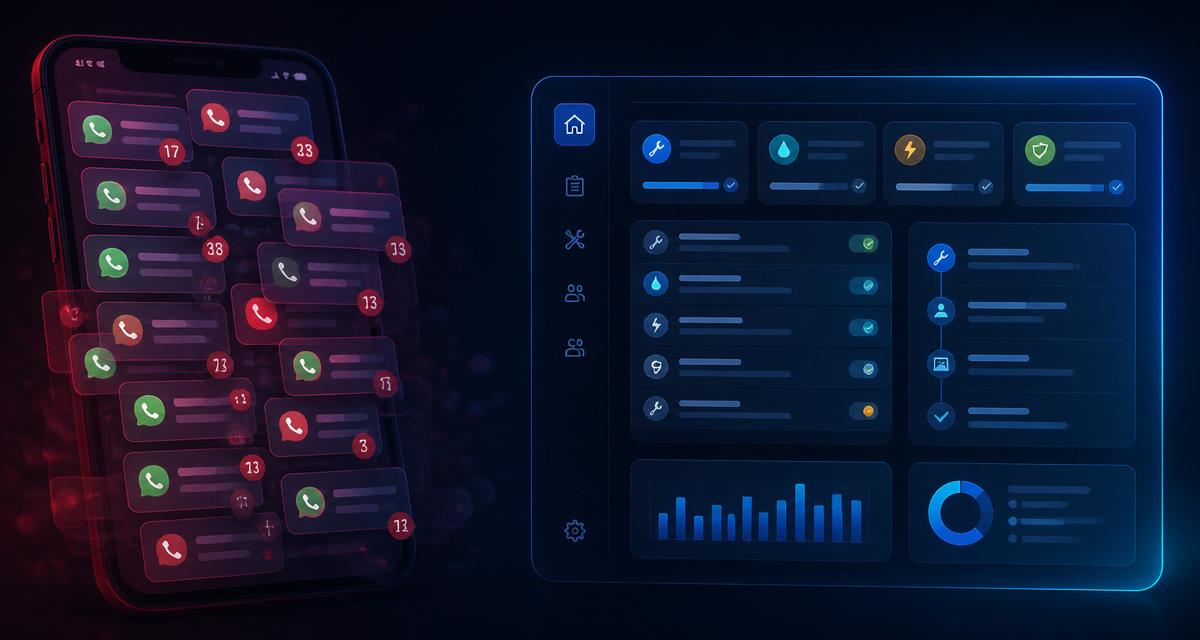
Most pros still handle this with a group WhatsApp and hope. It doesn't scale, and it burns out the tech who ends up doing all the work because they're the fastest to reply.
A proper emergency dispatch flow has a defined intake (single number or in-platform channel), an automated triage question set that categorises tier, a push to the on-call tech with all the details, and a customer confirmation with ETA. This whole flow can take 90 seconds if it's built properly.
The recovery day
Pros who do emergencies well take a recovery half-day after a heavy night. Not out of kindness — out of practicality. Tired techs make mistakes, and mistakes on standard work cost more than the emergency earned.
Build recovery time into your on-call comp structure. It pays for itself.
What to do this week
Set your three emergency rates. Publish them on your website and in your quote packs. Build your emergency van kit. If you have a crew, define your on-call rota and compensation.
Then, on the very next emergency call, charge the new rate. It will feel uncomfortable. The customer will pay. Every subsequent one will feel easier.
Absolutely handles emergency intake, triage, dispatch and customer confirmation as part of the standard job flow — so 11pm callouts run through the same system as scheduled work, with none of the chaos. Free for a limited time.